
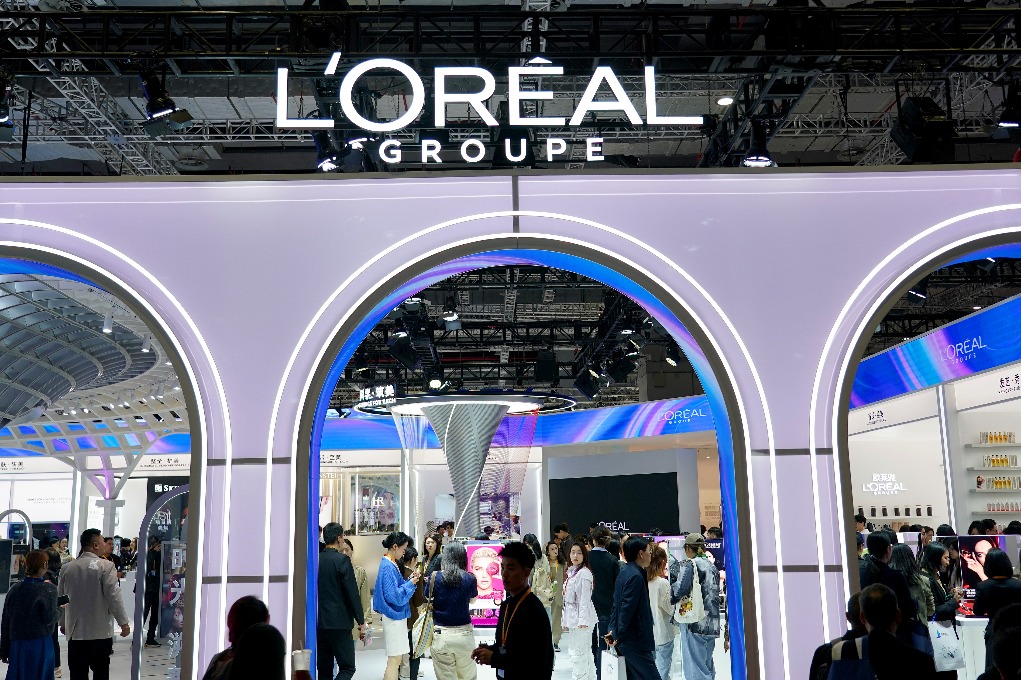

French cosmetics group L’Oreal announced recently two major industrial upgrades: the inauguration of the UPX Phase II smart manufacturing workshop and the launch of an industrial water management project during the 30th anniversary celebration on June 11 of L’Oreal’s Suzhou Plant, the group’s largest manufacturing base by production capacity.
The industrial water management project is aimed at saving over 180,000 metric tons of freshwater annually by the end of 2027.
Established in 1996 at Suzhou Industrial Park, the plant has undergone four phases of expansion over three decades. It now spans 154,000 square meters, operates over 100 production lines, serves core brands across four divisions, and manages over 2,500 product categories, with each product undergoing an average of 100 quality checks.
“It is here that L’Oreal established our very first footprint in China, laying the foundation for decades of growth. Suzhou remains the beating heart of our operations,” said Vincent Boinay, president of L’Oreal North Asia and CEO of L’Oreal China.
Boinay emphasized three key pillars for the plant’s development: unmatched performance, constant transformation, and dynamic acceleration. He noted that in China, over 60 percent of products are produced locally. The group’s first global smart fulfillment center, launched in Suzhou two years ago, has set a new benchmark for supply chain efficiency with a capacity of 7,000 parcels per hour.
The unveiled UPX Phase II smart manufacturing workshop integrates AI quality inspection into core production processes and leverages advanced robotics to improve production precision and quality stability, marking a new stage of the plant’s intelligent manufacturing upgrade.
“China is innovating so fast on AI, on robotics,” said Marc-Antoine Poulle, senior vice-president of L’Oreal North Asia and China Operations. He said that in the next three to five years, the Suzhou plant will pilot and commercialize the group’s global advanced manufacturing technologies.
In response to concerns about “machines replacing humans,” Lu Xiangling, director of L’Oreal Suzhou Plant, assured that machines are meant to empower, not replace, employees. AI and automation take over heavy, repetitive tasks, enabling staff to focus on higher-value activities like quality control and process optimization.
The plant enhances employee skills through three approaches: broadening basic AI knowledge, deepening expertise in production processes and quality control, and offering targeted training for equipment operation and system optimization, according to Lu.
As a digital operations test bed, the Suzhou plant and its smart fulfillment center have developed an integrated supply chain tailored to China’s e-commerce market, where e-commerce accounts for over 60 percent of L’Oreal China’s sales. The plant can produce 5,000 units per minute during peak shopping festivals, and the fulfillment center dispatches up to 150,000 parcels daily.
“The only way we can continuously satisfy consumers is by building an integrated digital system combining manufacturing and fulfillment center capabilities to deliver our e-commerce order,” said Poulle, noting that this agile supply chain model, refined in China, is being shared with the group’s overseas markets.
Sustainability is another cornerstone of the Suzhou Plant’s 30-year growth. Having reached 100 percent renewable energy in 2019 — the first plant in Suzhou to achieve this milestone — the site is now pioneering a new industrial water management project. Scheduled for completion by the end of 2027, the initiative will ensure 100 percent of water for industrial use comes from reused or recycled sources, saving over 180,000 tons of freshwater annually.
[email protected]
Tanks to chinadaily.com.cn
Please visit:
Our Sponsor
Like this:
Like Loading…
Разгледайте нашите предложения за Български трактори
Иберете от тук
Българо-китайска търговско-промишлена палата