
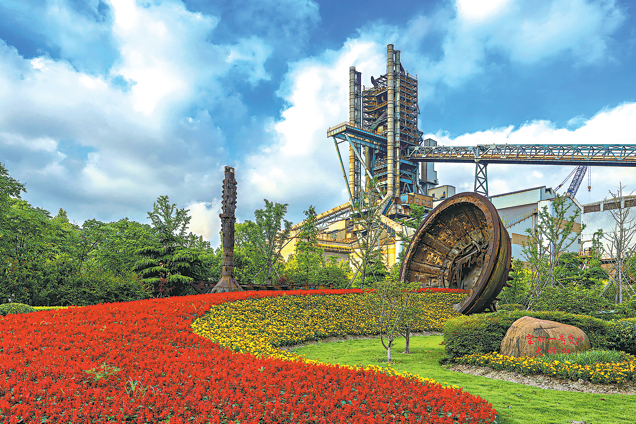

 Baosteel’s No 1 Blast Furnace will soon become a fully AI-powered smart blast furnace in Shanghai to make precise temperature predictions and ensure stable operations. LIU JIMING/FOR CHINA DAILY
It might be one of the world’s toughest engineering feats — keeping China’s first ultra-large blast furnace operating consistently at a temperature of around 1,510 degrees Celsius.
But this seemingly impossible task is now being streamlined and improved with the help of artificial intelligence.
Commissioned on Sept 15, 1985, Baoshan Iron and Steel Co’s No 1 Blast Furnace — with a capacity exceeding 4,000 cubic meters — has been operating for over 40 years. The towering furnace is located in Shanghai’s Baoshan district at a base of Baosteel, a subsidiary of China Baowu Steel Group.
Now, the 115-meter-tall structure is undergoing a technological revival and refinement of its operations thanks to the applications of AI.
Once the upgrading of the No 1 Blast Furnace is finished in the next few days, all four blast furnaces at the Baoshan base will be fully AI-powered. The technology will help reduce each furnace’s operating costs by over 10 million yuan ($1.48 million) annually and cut carbon emissions by 5 kilograms per metric ton of hot metal, setting a benchmark for intelligent manufacturing in the steel industry.
Blast furnace ironmaking — a core process in steel production — has long faced challenges such as highly complex operating conditions, multi-variable coupling, and heavy reliance on human experience.
The “black box” nature of the process has been a major barrier to intelligent upgrading of the sector and is described as “dirty, difficult and dangerous”, according to Wang Shibin, chief engineer of big data application at Baosteel’s ironmaking plant.
“Within the sealed furnace, where temperatures can exceed 2,300 C and even rock is fully molten, no instrument can be inserted for direct measurement. Yet, the furnace temperature is crucial to blast furnace production, directly determining product quality stability,” he said.
Poor control of furnace temperature and sulfur content can disrupt downstream steelmaking processes and increase production costs, Wang said.
Tanks to chinadaily.com.cn
Please visit:
Our Sponsor
Like this:
Like Loading…
Разгледайте нашите предложения за Български трактори
Иберете от тук
Българо-китайска търговско-промишлена палата