
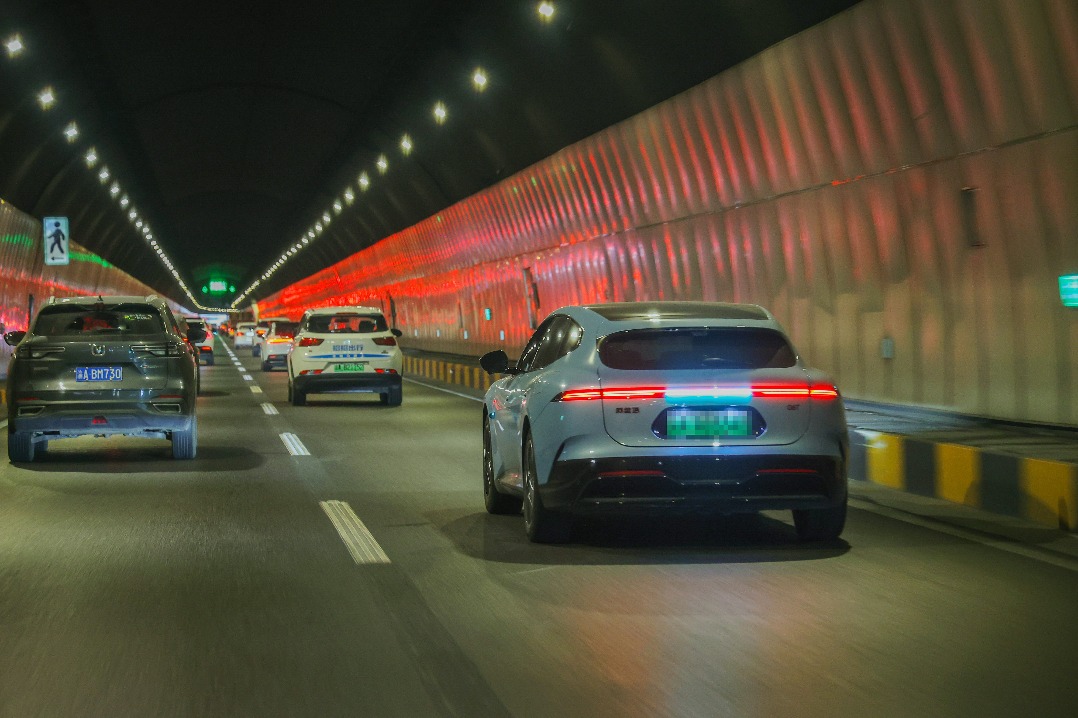

 A new energy vehicle with assisted-driving capabilities on the road in Chongqing, on July 29. [Photo/VCG]
Chinese consumers are among the most confident in the world when it comes to daily mobility safety, but the rapid development of intelligent vehicles is creating new challenges in ensuring that public expectations match technological realities, according to a new report.
The report by Economist Enterprise, supported by Brembo, shows that 94 percent of Chinese road users feel safe in their everyday travel, placing China among the markets with the highest levels of public confidence.
The study surveyed 6,157 respondents across 10 markets, including 5,135 road users and 1,022 mobility industry professionals, examining how consumers and industry experts view the future of mobility safety.
“In high-trust markets such as China, public confidence has grown alongside rapid, visible modernization — new infrastructure, smarter vehicles and more advanced mobility technologies,” said Pratima Singh, principal of policy and insights at Economist Enterprise, who led the research.
However, the report also highlights a significant gap between public perception and industry assessment.
In China, the difference between road users’ confidence in daily mobility safety and professionals’ evaluation of actual safety challenges reaches 80 percentage points, indicating a “trust gap” that could become increasingly important as vehicles become more automated.
The findings suggest that future mobility risks are shifting from traditional vehicle performance issues toward the interaction between people, machines and increasingly intelligent systems.
Globally, 30 percent of mobility professionals surveyed believe that drivers’ misunderstanding or misuse of driver-assistance systems is the leading cause of road safety issues.
Another 24 percent identify distraction caused by increasing in-vehicle functions as the most serious safety concern.
Meanwhile, two-thirds of industry professionals believe that some automakers’ advertising overstates the capabilities of driver-assistance technologies, potentially creating unrealistic expectations among users.
“When people believe systems are safer than they actually are, they often fail to maintain the level of attention required to stay safe on the road,” Singh said.
Despite their strong confidence, Chinese consumers are not simply relying on technology without caution.
The survey shows that 85 percent of Chinese respondents support stricter road safety management measures, including lower speed limits, wider use of speed cameras and paying more for safer mobility services.
The results indicate that consumers are willing to accept certain restrictions and costs in exchange for improved safety, highlighting the importance of cooperation among automakers, regulators and technology providers.
“Closing the trust gap requires collective action across the mobility ecosystem,” said Matteo Tiraboschi, executive chairman of Brembo.
“Industry must continue to innovate responsibly, policymakers must create effective regulatory frameworks, and together they must help people understand both the capabilities and limitations of new technologies.”
As vehicles become increasingly connected and automated, safety is no longer determined only by mechanical excellence. Instead, it depends on the seamless integration of hardware, software and human behavior.
The report emphasizes that the industry needs to provide clearer communication about emerging mobility technologies, particularly driver-assistance systems, so that users understand both what these systems can do and where their limitations lie.
At the same time, improving human-machine interaction and ensuring drivers can effectively take control at critical moments remain key challenges for the entire automotive ecosystem.
China’s intelligent and connected vehicle industry is also moving toward more standardized development through regulatory efforts.
On June 27, China officially issued a mandatory national standard about ADAS safety requirements, which will take effect on Jan 1, 2027.
The standard clarifies the functional boundaries of combined driver-assistance systems, requires companies to strengthen their safety responsibilities and calls for enhanced user training and multi-level evaluation mechanisms.
The introduction of the standard marks a shift for China’s intelligent vehicle industry from rapid expansion toward a more regulated stage of human-machine collaboration.
Industry observers said that as smart vehicles enter wider adoption, the next stage of competition will not only focus on technological capability, but also on building consumer trust through responsible innovation and transparent communication.
For the future of mobility, the challenge is not simply making vehicles smarter, but ensuring that people and technology can work together safely, they said.
Tanks to chinadaily.com.cn
Please visit:
Our Sponsor
Like this:
Like Loading…
Разгледайте нашите предложения за Български трактори
Иберете от тук
Българо-китайска търговско-промишлена палата