
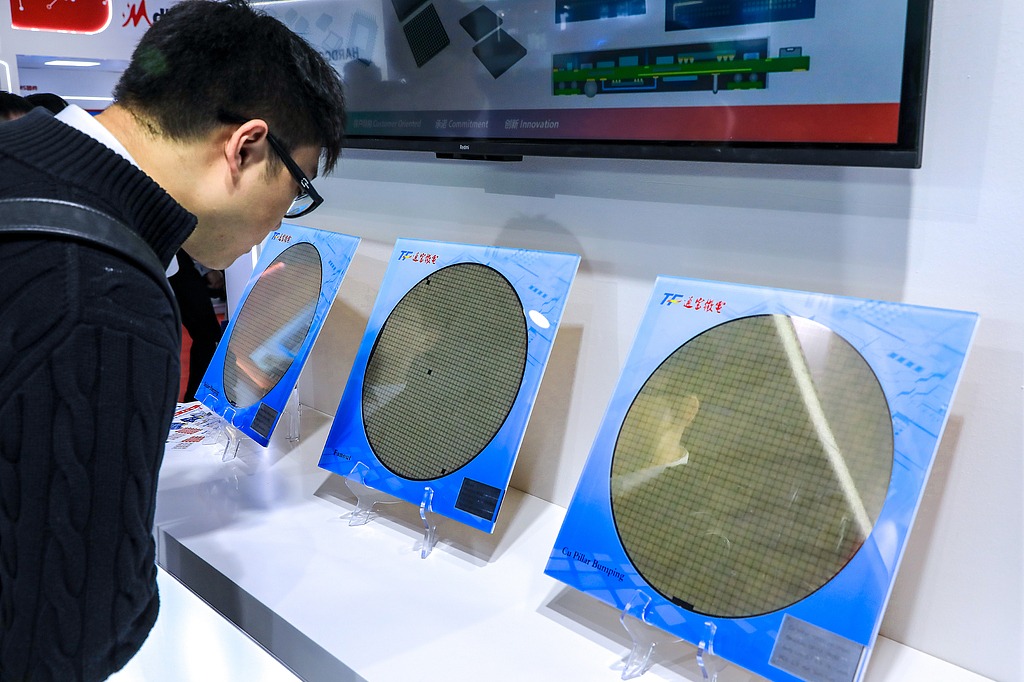

China’s electronic information manufacturing industry is set to embark on a transformative journey from scale expansion to quality enhancement and resilience building during the 15th Five-Year Plan (2026-30) period, experts and corporate executives said.
Guo Chaoxian, a researcher at the Institute of Industrial Economics of the Chinese Academy of Social Sciences, said while the global competition landscape is forecast to continue becoming more decentralized and regionalized in the upcoming years, China’s international competitiveness in electronic information manufacturing is expected to strengthen further.
Revenue of China’s major electronic information manufacturing enterprises has grown steadily from 14.1 trillion yuan ($2.1 trillion) in 2021 to 17.4 trillion yuan in 2025, achieving an average annual growth rate of 5.4 percent, driven by consumer electronics upgrades and surging global digital transformation demand, according to the Ministry of Industry and Information Technology.
The industry’s global footprint has been further cemented. For instance, according to the China Photovoltaic Industry Association, by the end of 2025, China’s production capacity accounted for 96 percent of global polysilicon, 96.2 percent of wafer, 91.3 percent of cell and 80.1 percent of module production — all ranking first worldwide.
“China’s electronic information manufacturing industry has consistently accounted for more than one quarter of the global market throughout the 14th Five-Year Plan period, and this growth momentum is expected to continue through the 15th Five-Year Plan period,” Guo said.
According to a plan for stabilizing the growth of the electronic information manufacturing industry (2025-26) jointly issued by the Ministry of Industry and Information Technology and the State Administration for Market Regulation, the average added value growth rate for computer, communication and other electronic equipment manufacturing is targeted at around 7 percent, with overall industry revenue growth exceeding 5 percent annually.
What’s more, value creation logic is undergoing a fundamental shift — from “hardware manufacturing value” to “data and service value” — Guo said, as artificial intelligence hardware is poised for an explosion.
The US market research company IDC projected that China’s total AI investment will exceed $100 billion by 2028, with a five-year compound annual growth rate of 35.2 percent. The State Council’s opinions on deeply implementing the “AI+” action set the target that by 2027, the penetration rate of new-generation intelligent terminals and intelligent agents will surpass 70 percent.
Lenovo Group Chairman and CEO Yang Yuanqing said that when AI deeply integrates with the real economy, China’s rich data resources, diverse application scenarios and vast user base will transform into unique advantages for building a modern industrial system.
Lenovo has developed a global supply chain intelligent agent using proprietary technologies, achieving multi-agent collaboration across demand forecasting, parts procurement, manufacturing and logistics — cutting supply chain decision-making time by more than half, Yang said.
Lenovo has also applied hybrid AI solutions in manufacturing, healthcare, transportation and agriculture, helping Yili Group restructure its supply chain to nearly double on-time delivery rates, he added.
Meanwhile, as vehicles are evolving from mere transportation tools into mobile intelligent terminals, this trend is also fueling surging demand for automotive chips, power semiconductors, sensors, cockpit electronics and high-precision navigation systems, experts added.
[email protected]
Tanks to chinadaily.com.cn
Please visit:
Our Sponsor
Like this:
Like Loading…
Разгледайте нашите предложения за Български трактори
Иберете от тук
Българо-китайска търговско-промишлена палата