
If you ask someone in Wuhan what East Lake is, the question usually elicits a pause.
Not because people do not know the answer, but because there are too many.
The lake on the eastern side of the provincial capital of Hubei province is one of China’s largest urban lakes, spanning about 33 square kilometers — roughly five times the size of the famed West Lake in Hangzhou, Zhejiang province. It is home to a 105-kilometer greenway system linking forests, wetlands, hills, villages, and lakeside parks.
The greenway project has collected an impressive list of awards, including the China Construction Engineering Luban Prize, one of the country’s top honors in construction projects.
Poets once wandered here. Mao Zedong stayed here dozens of times. Chinese military leader Zhu De predicted that East Lake would one day surpass West Lake. The lake has won international urban-planning awards. On major holidays, it has never failed to pack in residents and travelers alike.
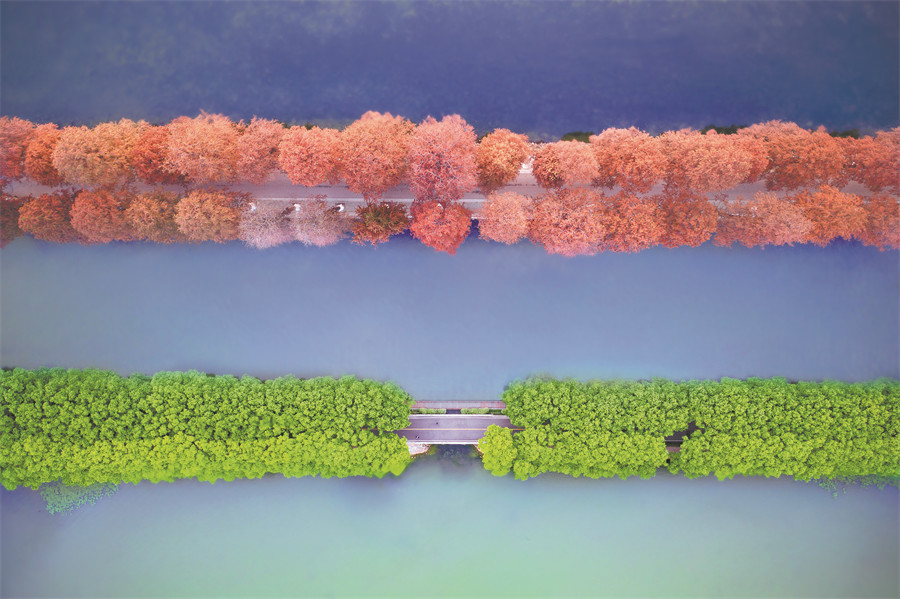
Aerial views of the East Lake Greenway in Wuhan, Hubei province, in different seasons. [Photo provided to China Daily]
However, no answer can fully articulate what it’s like to encounter a lake of this scale. You arrive and do not know where to begin. The lake exceeds the frame of a camera lens.
By late spring, the cherry blossoms around East Lake are long gone, but the crowds remain.
The asphalt along the greenway is damp from morning dew. Cyclists wobble past on rented bicycles. Young parents push strollers slowly along the lakeside. Some people simply sit on benches facing the water, lost in reverie.
The greenway loops through seven themed sections, forming a continuous ring around large sections of the lake. Along the way are wetlands, restored shorelines, cedar groves, Chu-style pavilions, village roads, and newly opened hiking trails threading through the surrounding hills.
At the north gate of Moshan Hill, Wei Yun clips her guide badge on her shirt and greets the first group of guests.
Wei has worked at East Lake for eight years, almost as long as the greenway has existed. She has guided thousands of visitors along the same routes. She knows where the cherry blossoms bloom first in spring, where people stop to cool off in summer, and where maple leaves turn their deepest red in autumn.
Once the group enters the lakeside section near Moshan, the view suddenly explodes.
Water spreads outward in immense sheets of silver-blue. The distant hills beyond the far shore lie low like sleeping animals beneath a hazy sky.
East Lake’s transformation is the kind of thing people notice beneath their feet, Wei notes.
The lakeside path of East Lake stretches to the heart of the lake and is a popular cycling route. [Photo provided to China Daily]
Before the greenway was built, many of the roads around the lake were mixed-use corridors where pedestrians, bicycles and cars competed for the same space. During busy seasons, tour groups constantly had to dodge traffic.
Now the routes are separated.
“There are roads for walking, roads for cycling, and roads for cars,” Wei says, pointing first at the path beneath her feet and then toward a narrow branch road disappearing into a nearby village.
The village road still allows vehicles, but the greenway does not.
The seemingly simple distinction has, in practice, reshaped how people move around the lake.”People have different needs,” Wei says.
“Young couples go to the pink Ferris wheel. One full rotation takes exactly 13 minutes and 14 seconds. Very romantic,” she elaborates, adding that the helium balloon offering a full view of the whole lake has also been a hit among visitors of all ages.
Around the lake, visitors drift toward different corners — the pink Ferris wheel, the cable car ascending Moshan, the reconstructed Chu City Gate, and stretches of artificial beach that attract crowds during summer weekends.
“Everyone finds a spot. That’s why 300,000 people can be here at once, and it never feels too crowded.”
The changes also extend to the shoreline itself. For years, rainwater rushed directly off the pavement and into East Lake, carrying mud, debris and runoff. Today, many sections have been rebuilt as gradual ecological slopes layered with stone, reeds and wetland vegetation intended to absorb and filter water before it reaches the lake.
“It’s part of the ‘sponge city’ concept,” she explains.
The giant art installation resembling fried eggs scattered along the greenway embodies the fusion of ecology and art. [Photo provided to China Daily]
She remembers when summer algae regularly spread across parts of the lake, turning sections of the water green during the hottest months. Now it is far less common.
Further along, towering dawn redwoods rise directly from the shallows like green pillars. Some were planted in the 1960s, when soldiers and local residents reportedly carried soil basket by basket, manually building the earliest lakeside roads.
The following generation then faced a harder question of what not to tear down.
For one stretch near Moshan, Wei points out that early plans called for widening the route to six meters — the minimum for international cycling events. But 27 mature trees lined the roadside, so authorities decided to keep the road as it was, and the trees are still standing.
That trade-off was repeated across East Lake. Routes bent around camphor groves. Maples and tallow trees were transplanted into existing clearings rather than new ones. On the village tracks, the path still curves around the old camphor groves.
Down an inconspicuous road approaching the villages in the lakeside neighborhood, entrepreneur Yu Xun recently opened a family campsite on land once left abandoned.
The play of light and shadow through the grove at East Lake makes for a favorite spot among photographers. [Photo provided to China Daily]
He invested more than 3 million yuan ($442,880) in the project, signing an eight-year lease with the landowner.
“Originally, this was just waste ground. Construction rubble was everywhere,” Yu says.
Now the site contains a cafe, children’s play areas, fishing ponds, and artificial streams where children catch shrimp and small fish.
Business is unpredictable. Weekends are packed. Rainy weekdays can empty the place entirely.
Some visitors come only to photograph the scenery. Others spread picnic mats and remain all afternoon.
“They’re all good visitors,” Yu says with a laugh.
He understands the risks. The popularity of outdoor family recreation could fade, tourism patterns often shift, and policies could change.
The long causeway is a classic feature of the East Lake, connecting history with living ecology. [Photo provided to China Daily]
Still, he believes East Lake is moving in a direction worth betting on.
Wei says the campsite is among many activities and infrastructure that have emerged around East Lake — hiking routes, cycling culture, lakeside businesses, outdoor concerts, and night walks.
“They appear gradually, like plants rooting themselves along the shore,” she says.
As evening approaches, the crowds along the greenway usually begin to thin.
Near the entrance to the Seven Hills trail, workers stack construction materials beside newly installed signposts. The trail is scheduled to fully open before October. When it does, the seven mountains will be connected by proper stone steps, observation platforms, and fire watchtowers.
Wei is familiar with this kind of transformation, as she has seen farmland turn into parking lots, dirt paths become six-meter-wide asphalt roads, and empty fields become playgrounds.
“New things keep popping up, but the lake stays the same. That’s what people come for,” she says.
Down by the water, another tour group gathers at Moshan’s north gate. Wei checks her watch, bids farewell to her old guests, and walks toward the new ones.
She believes the greenway will keep growing, but someone like her will always need to show the way.
The long causeway is a classic feature of the East Lake, connecting history with living ecology. [Photo provided to China Daily]
Like this:
Like Loading…
Разгледайте нашите предложения за Български трактори
Иберете от тук
Българо-китайска търговско-промишлена палата