
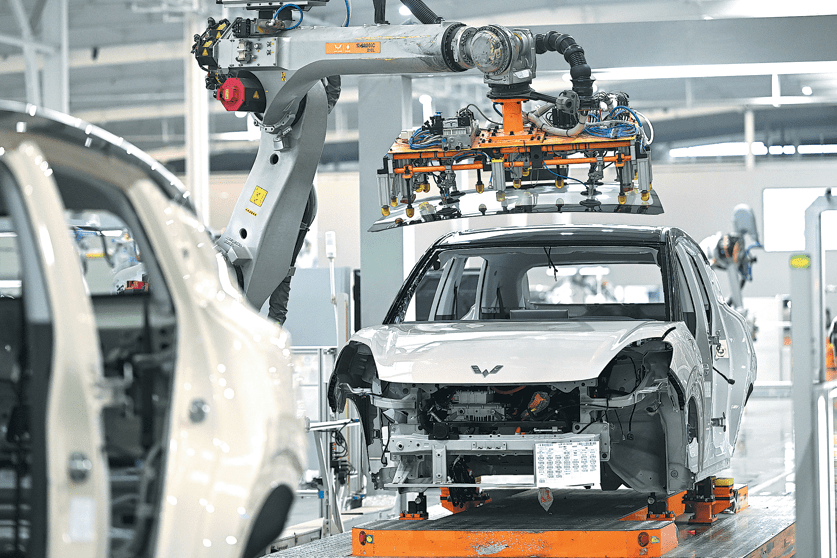

 A Wuling vehicle is assembled on an automated production line in Liuzhou, Guangxi Zhuang autonomous region, on Jan 30. LI HANCHI/FOR CHINA DAILY
China should establish its own intelligent driving standards and use the Guangxi Zhuang autonomous region as a “bridgehead” for promotion to Southeast Asia, a national lawmaker said.
That would mark a significant step by the nation in reshaping the global automotive landscape, according to Yao Zuoping, a deputy to the National People’s Congress, the nation’s top legislature, and Party chief and deputy general manager of SAIC-GM-Wuling Automobile.
Yao made the proposal before the annual meeting of the NPC began last week.
The call comes as policymakers seek to preserve the country’s competitive edge in new energy vehicles amid mounting pressure from global rivals such as Tesla.
Yao said the country’s intelligent driving sector has reached a critical juncture. The penetration rate of L2-level assisted driving — also known as partial automation — exceeded 64 percent in China in the first 10 months of 2025.
“The industry is moving beyond the electrification phase and into the second-half race, one that is centered on artificial intelligence,” Yao said, adding that the sector is expected to become a trillion-yuan-level market by 2027.
“Intelligent transformation is becoming a determining force in industrial progress,” he added.
He warned that global competitors are racing to integrate advanced AI software with specialized chips in a bid to turn self-driving technology into a profitable commercial reality.
To counter this, Yao proposed developing China’s own intelligent driving standards beginning with commercial applications such as automated parking and logistics — areas where technology is relatively mature and safety boundaries are clear.
These low-speed scenarios, he argued, are well-suited for pilot programs and would help reduce reliance on Western-dominated regulatory frameworks.
A successful rollout, he said, would establish a “Chinese standard paradigm” that could later inform regulations for more complex urban driving environments.
Yao also called for amendments to the Road Traffic Safety Law to clarify the legal status of intelligent vehicles, as well as liability in the event of accidents.
To accelerate mass adoption, he recommended offering tax breaks, reduced insurance premiums, and preferential road access for vehicles equipped with advanced systems that meet national standards.
In parallel, he called for leveraging China’s State-led system to deploy autonomous vehicles in public services, such as public transit, sanitation, and delivery fleets.
These moves, he said, would generate vast amounts of real-world data to drive rapid technological iteration and cost reduction, creating a self-reinforcing cycle of application and innovation while demonstrating the technology’s safety to the public.
He also highlighted the importance of nurturing a competitive industrial ecosystem, noting that the global race is increasingly defined by system-level capabilities, as seen in the rivalry between Tesla’s Full Self-Driving and Huawei’s Advanced Driving System.
Yao proposed positioning Guangxi as a strategic bridgehead for exporting China’s new-energy and intelligent vehicle technology to Southeast Asia.
Citing its proximity to the region, established automotive base, and policy advantages under the Regional Comprehensive Economic Partnership agreement, he suggested establishing a joint innovation platform in Guangxi for China and the Association of Southeast Asian Nations.
The platform would focus on technical adaptation and standard coordination for tropical climates and local traffic scenarios.
Contact the writers at [email protected]
Tanks to chinadaily.com.cn
Please visit:
Our Sponsor
Like this:
Like Loading…
Разгледайте нашите предложения за Български трактори
Иберете от тук
Българо-китайска търговско-промишлена палата