
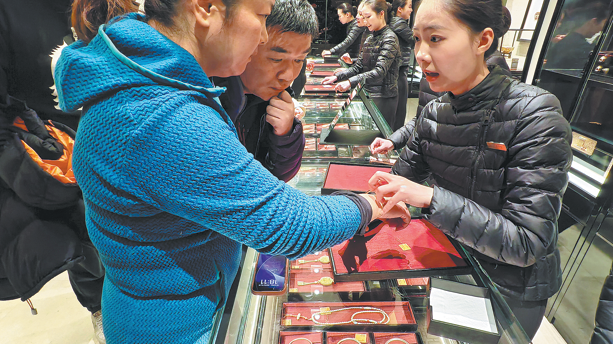

 A customer tries on a gold bracelet on Tuesday at the debut store of Laopu Gold, a high-end Chinese brand specializing in traditional gold craftsmanship, in Shanghai. CHEN YUYU/FOR CHINA DAILY
As record gold prices meet a revival of traditional craftsmanship, Chinese people’s appetite for so-called ancient-style, or gufa, gold jewelry reflects more than investment logic. It signals a cultural reawakening — where traditional aesthetics, intangible heritage and identity-driven consumption are becoming new engines of domestic demand.
When a Shanghai resident surnamed Wang began investing in gold jewelry in September, he was driven by his curiosity about traditional craftsmanship. Earlier last year, Wang had already snapped up several pieces from a leading brand. That journey eventually led him to a smaller name: Lamchiu.
“The moment I held a Lamchiu pendant necklace, I realized how superior handmade craftsmanship is from mass production,” Wang said.
In September, he set his sights on a Lamchiu piece weighing about 50 grams. At the time, spot gold was trading above 700 yuan ($98) per gram, while Lamchiu’s in-store price was closer to 1,300 yuan per gram.
With no inventory available, Wang turned to the local resale market, paying about 60,000 yuan. Less than three months later, resale market estimates for the same piece had risen to nearly 100,000 yuan.
China’s gold market is experiencing a rare double boom: record-high bullion prices alongside a surge in demand for gufa gold jewelry. The style emphasizes handcrafted techniques such as filigree, engraving and symbolic Chinese motifs, and is sold at a significant premium to spot gold prices.
Founded in 2006 in Lanzhou, Gansu province, Lamchiu operated quietly for years. The breakout happened when it started livestreaming in recent years. Despite having just one physical store in Lanzhou, the brand’s annual revenue has multiplied several times, surpassing 500 million yuan as of November. Orders routinely exceed available supply. Founder Ma Chaoxian attributes the reason to firm priorities: nearly all designs are original, and speed is sacrificed in favor of handcrafted techniques.
“Our advantage is originality, extreme craftsmanship and cultural expression,” Ma said, noting Lamchiu’s efforts to integrate global filigree techniques into Chinese jewelry traditions.
That trajectory has drawn investment of more than 100 million yuan, according to news platform 36Kr, with Dayone Capital as the sole investor. The funding will support product innovation, branding, channel expansion and the development of a new production base.
Industry leader Laopu Gold’s performance shows how quickly the once-niche segment is expanding. In the first half of 2025, the company posted average sales of more than 460 million yuan per store, with revenue jumping 251 percent year-on-year to 12.35 billion yuan and profit rising nearly 286 percent to 2.26 billion yuan.
Smaller players are also attracting capital. Borland, a filigree-focused gold brand, raised more than 100 million yuan in a Series A round last year, with investors including luxury group Kering.
For artisans, the shift is increasingly evident. Ma Sai, a recognized inheritor of Tianjin’s intangible cultural heritage traditions, said his company, which mainly produces filigree-inlay jewelry and accessories made from gold, silver and copper, “has seen more orders”.
“The recent rise of ancient-style gold and traditional jewelry is closely linked to stronger national efforts to promote intangible cultural heritage,” Ma Sai said.
Policy support has reinforced these trends. The government is actively encouraging revitalization of traditional craftsmanship through innovation and design, aiming to boost consumption and stimulate economic growth.
“What buyers are really looking for is the memory and the story behind intangible cultural heritage,” he said.
[email protected]
Tanks to chinadaily.com.cn
Please visit:
Our Sponsor
Like this:
Like Loading…
Разгледайте нашите предложения за Български трактори
Иберете от тук
Българо-китайска търговско-промишлена палата