
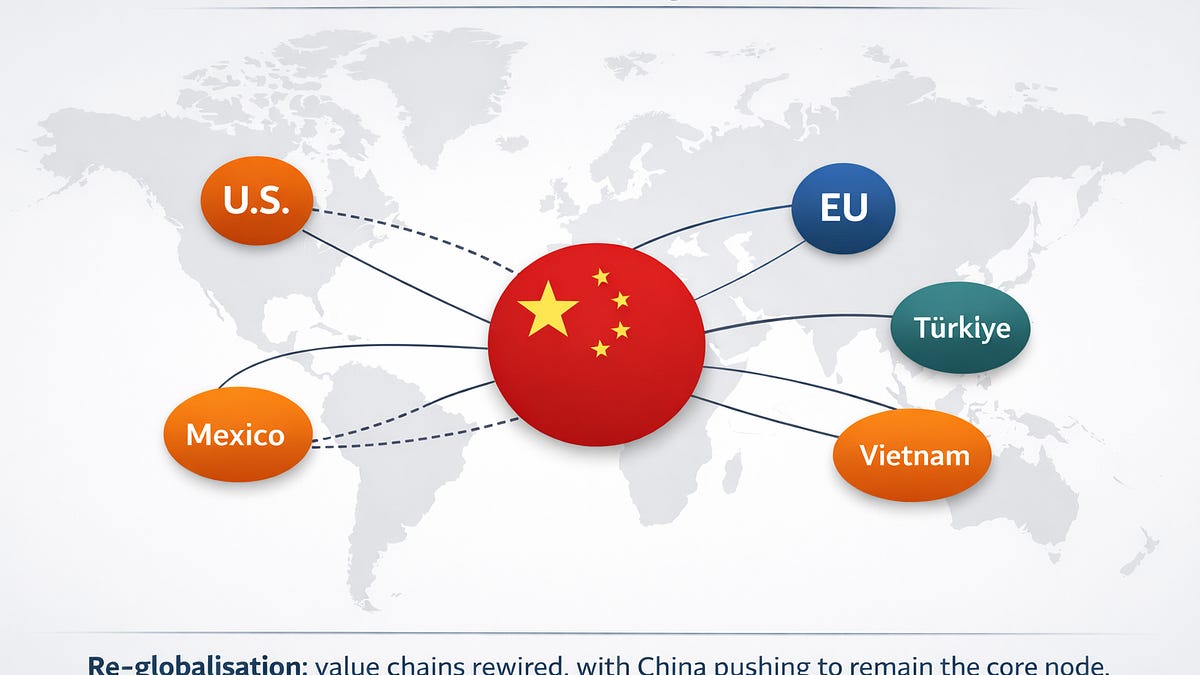

We expect China to add a layer of make-up to its international trade narrative in 2026, from leadership speeches and ministry readouts to state-media framing.
The message will be that globalisation is not ending but being reorganised. China will present itself as indispensable and will push back against others’ efforts to rewrite trade rules without China.
In strategic terms, this is not really about trade theory. It is narrative management, with a specific aim: to normalise “re-globalisation” as the right label for the moment, and to make “China as a core node” sound like a fact rather than a choice.
By insisting that value chains are being rewired rather than shrinking, Beijing challenges the Western language of “decouple” and “de-risk”. The implied request to policymakers elsewhere is straightforward:
stop treating China as an exception to be contained and start treating it as a central node in the next configuration of global trade.

A related theme is the rise of “connector economies”. China will highlight countries that sit between blocs, such as Vietnam, Türkiye, Morocco, or Mexico, depending on the audience. This framing is not neutral. It normalises a world where companies and governments work around political lines rather than obey them. The underlying message to the EU and the U.S. is that politics may harden, but industry will still rely on China-linked networks.
China will also continue to defend industrial policy without apology. It will argue that others do it too. What China will not say explicitly is that it will protect its own advantages aggressively. In sectors where China controls critical capacity, such as rare-earth processing, the strategic goal is not only dominance today. It is to keep rivals from building competing capacity at comparable cost. If alternative supply chains emerge, China can respond with aggressive pricing and administrative measures to make those projects financially fragile.
Despite repeated claims of multilateralism, China also understands that trade governance is shifting away from big WTO-style packages towards modular, issue-by-issue rulemaking. China’s priority will be to shape those modules, often through targeted deals and standards work, and to ensure that any new rules leave space for China’s model.
Our forecast, based on the latest-vintage data rather than the figures available at the time of release, points to around 4% nominal growth in 2025. That is compatible with roughly 5% real growth, implying a GDP deflator of about −1% and reflecting today’s weak consumption and subdued price environment.
For Q4 2025, we forecast GDP of 38.6953 tn yuan, implying just under 4% nominal growth versus the same quarter in 2024.
For 2025, we forecast GDP of 140.1989 tn yuan.
 China’s 2025 GDP figures are scheduled to be released on January 20, 2026
It signals persistent price pressure and weak demand, with soft consumption keeping CPI near zero and depressed factory-gate prices (PPI) dragging nominal growth below real growth.

UNCTAD’s 2025 estimates point to global goods trade rising by about 6%, to roughly $26.5 tn, from around $25.0 tn in 2024. On our calculations, China accounts for 14.1% of global exports and 8.8% of global imports. That gap implies an exceptionally large goods surplus.
We are not aware of any previous case of a single country recording an annual goods surplus above $1 tn.
For services, the same estimates point to global services trade rising by about 10%, to roughly $9.1 tn, from around $8.3 tn in 2024. On our calculations, China accounts for 4.6% of global services exports and 6.8% of global services imports, implying a services volume and deficit that appear to reflect features of its economic and political system more than any external constraints.
In our view, amid tariff turbulence, front-loading was an important driver of the 2025 upswing in goods trade, especially early in the year.
The European Union’s carbon border tax came into force on 1 January 2026, as the European Commission confirmed a week earlier, marking the start of full implementation of the EU’s Carbon Border Adjustment Mechanism, or CBAM.
Beijing’s response has been sharper than routine displeasure. On 1 January, China’s Ministry of Commerce condemned the CBAM, calling provisions targeting China “unfair and discriminatory” and warning it would take “all necessary measures” to safeguard its interests. Trade repercussions now look hard to avoid.
Additionally, we wouldn’t be surprised if Mr Trump adds CBAM to his list of grievances against the EU. Time will tell.
We believe China’s trade remedy, which sets country-specific beef import quotas with a 55% over-quota tariff, reflects domestic economic weakness more than any broader shift in trade policy.
The Ministry of Commerce spokesperson frames it as phased support to help the domestic industry through a difficult period, and that framing speaks volumes
According to China, the Netherlands is using administrative powers to meddle in Nexperia’s management. It frames this behaviour as the root cause of the current supply-chain disruption. Chinese state media claim the Dutch side should “bear full responsibility” for the resulting instability and should stop “further moves in the wrong direction” and take steps to restore supply-chain “stability and security”.


Some EU wine regions increased their exports to China in 2025, but most are starting from a low base.

Most EU wine regions saw exports to China fall.


Xi and Maduro rose to power at roughly the same time (2013).
When they met in Beijing in 2015, they pledged to deepen cooperation in areas such as energy and finance, and to maintain close coordination on international affairs but didn’t translate into trade.

In reality, it was all about crude oil


Italy and the EU are trying to tackle the same issue: a surge in very cheap parcels shipped directly into Europe from outside the EU, often via platforms such as Shein or Temu.
The EU has agreed an EU-wide customs charge, due to start on 1 July 2026, on low-value e-commerce imports (under €150). It will apply automatically in every EU country, including Italy.
Italy is now proposing its own national levy on the same type of small parcels. In other words, the EU measure would become the baseline from mid-2026, and Italy’s proposal would add an extra layer (unless Italy later decides to remove it or adjust it once the EU charge takes effect.)
More than thirty years ago, a Krugman paper on economic geography helped lay the groundwork for the work that later earned him the Nobel Prize in Economics. The last time we checked, it had been cited more than 22,000 times by other researchers. Below is what he writes on January 4, 2026.
One doesn’t have to be a crude, Trumpian-style trade protectionist to understand that it’s a major problem for the global economy when an economy the size of China’s runs persistent, extremely large trade surpluses. China’s trade surpluses are causing major economic disruptions around the world – particularly in the US and in Europe. Furthermore, China is an authoritarian regime. Its growing dominance of several strategic industries poses serious concerns, both in terms of national security and technology capture.
We are committed to sharing with you the best trade analysis we have to offer. If you would like to share something with us, feel free to comment in the section below or drop us a line at [email protected]
Like this:
Like Loading…
Разгледайте нашите предложения за Български трактори
Иберете от тук
Българо-китайска търговско-промишлена палата