
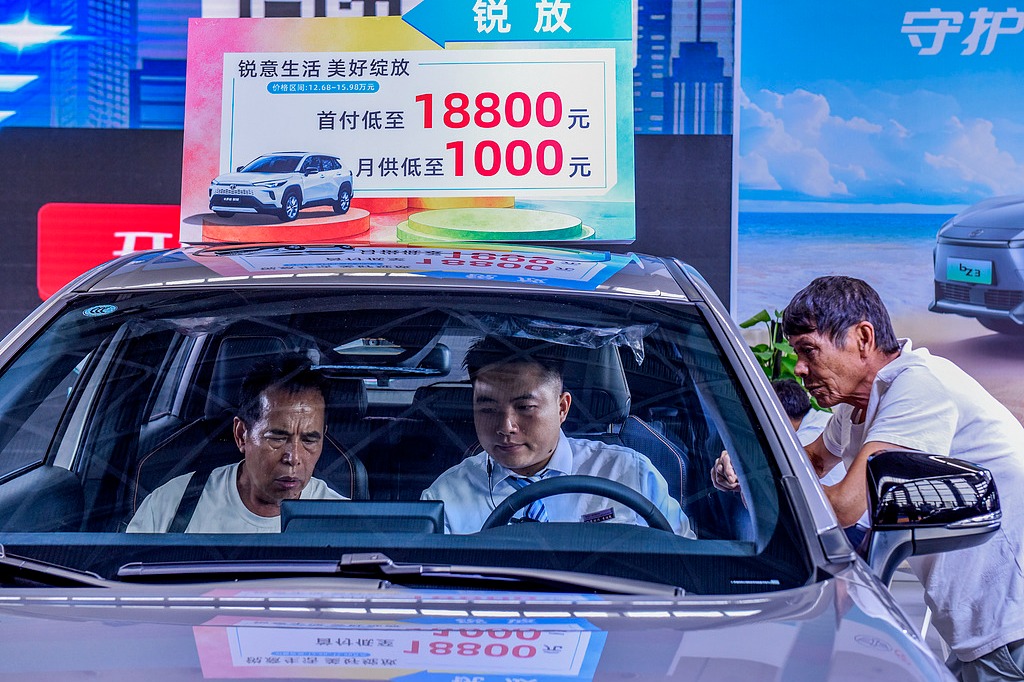

Satisfaction among owners of gasoline vehicles in China improved notably in 2026, driven by stronger vehicle performance, better user experience and growing demand for intelligent features, according to the latest J.D. Power China Automotive Performance, Execution and Layout Study.
Overall owner satisfaction with internal combustion engine vehicles rose 11 points year-on-year to 762 points on a 1,000-point scale, marking a significant improvement despite intensifying competition from new energy vehicles.
The 2026 study is based on responses from 14,184 owners who purchased ICE vehicles between July 2025 and February 2026.
The survey covered 131 models and 37 brands across 81 major Chinese cities and was conducted between January and April 2026.
Vehicle performance emerged as the biggest contributor to the increase, with satisfaction in the category rising 21 points from 2025.
Satisfaction with entering and exiting the vehicle and infotainment systems also improved substantially, both gaining 17 points year-on-year.
The findings suggest that ICE vehicle buyers are placing increasing emphasis on intelligent interaction and overall user experience, areas traditionally associated with NEVs.
“Improvement in ICE vehicle technology performance has been driven not only by the innovation of NEV technologies, but also by the growing adoption of hybrid models,” said Sean Wang, general manager of vehicle product competitiveness solutions at J.D. Power China.
According to Wang, hybrid powertrains have helped overcome traditional efficiency limitations while delivering better power output and improvements in noise, vibration and harshness performance.
“Currently, hybrids are mostly offered by international and premium brands and command a price premium compared to conventional ICE vehicles. However, as consumer demand for intelligence, performance and fuel economy continues to grow, more domestic brands are expected to join the competition,” he said.
The study also showed that the performance gap among premium, international mass-market and domestic Chinese brands continued to shrink.
Among premium brands, overall satisfaction rebounded by four points to 770. Mass-market international brands improved by 13 points to 760, while domestic Chinese brands also gained 13 points, reaching 758.
The narrowing gap reflects growing competitive pressure across the market as domestic automakers continue improving product quality, technology integration and customer experience.
At the same time, J.D. Power noted that differentiation among brands is becoming increasingly difficult to maintain, particularly as intelligent features and hybrid technologies become more widely available.
The study identified changing market dynamics in China’s lower-tier cities as another important trend.
According to Wang, sales of traditional ICE vehicles in Tier-3 and Tier-4 cities have declined sharply while NEV penetration continues to rise, reflecting growing consumer demand for fuel efficiency and technology features beyond China’s largest urban centers.
“OEMs need to rethink their ICE product strategy for these markets to defend this important customer base,” Wang said.
He also pointed to a growing gender gap in owner satisfaction. While satisfaction among female NEV owners increased by 16 points this year, improvements among female ICE vehicle owners lagged significantly behind those reported by male owners.
The finding suggests automakers may need to further adapt vehicle design, usability and feature offerings to better meet the expectations of female consumers.
One of the clearest shifts identified in the study was the growing role of hybrid powertrains in the premium segment.
The share of hybrid models in the premium market increased to 43.4% in 2026 from 30.8 percent in 2024, surpassing the overall market average.
J.D. Power said premium automakers are increasingly incorporating hybrid electric vehicle technology into their core product portfolios as a way to enhance performance, efficiency and refinement while maintaining the characteristics traditionally associated with premium ICE vehicles.
The findings suggest that rather than disappearing, conventional powertrains are evolving through electrification.
Among premium brands, Land Rover ranked highest in overall APEAL performance with a score of 824, followed by Porsche at 813 and Lexus at 790.
FAW-Volkswagen led the mass-market segment with a score of 780, ahead of Chery at 776 and Haval at 774.
Among domestic Chinese brands, Chery ranked first with 776 points, followed by Haval at 774 and GAC Trumpchi at 772.
Tanks to chinadaily.com.cn
Please visit:
Our Sponsor
Like this:
Like Loading…
Разгледайте нашите предложения за Български трактори
Иберете от тук
Българо-китайска търговско-промишлена палата