
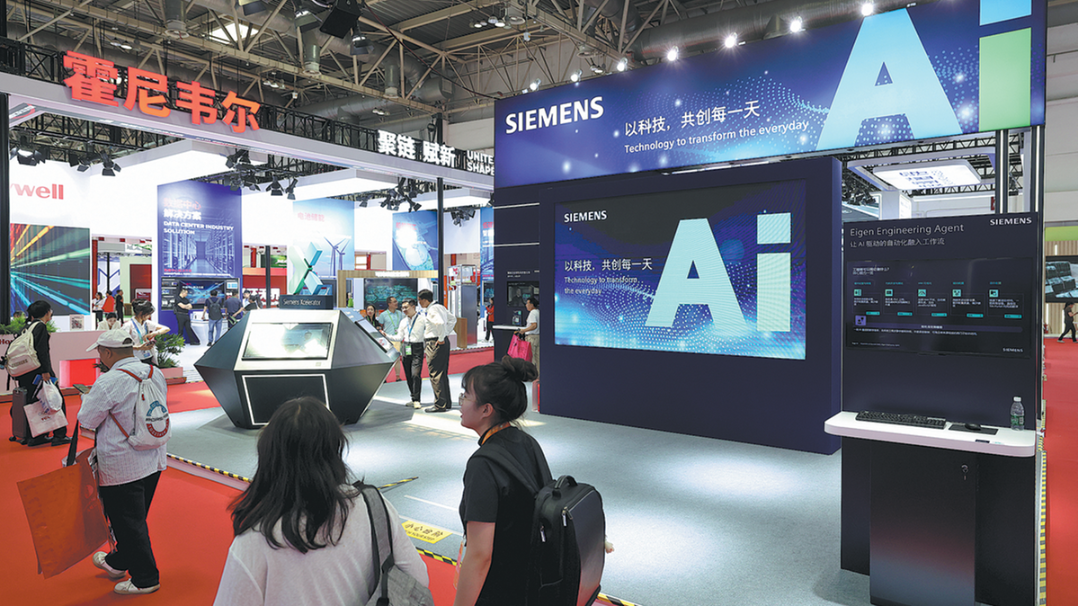

 Visitors get to know information at Siemens’s exhibition area during the fourth China International Supply Chain Expo in Beijing on June 23. ZHANG CHENLIN/XINHUA
For senior executives from multinational companies including Germany’s Covestro AG and the United States’ Boeing Co and Carrier Global Corp, June brought a steady stream of visits to China, where they unveiled expansion plans, launched new projects and participated in the fourth China International Supply Chain Expo in the world’s second-largest economy.
Among them, Covestro made a major investment announcement in late June. The German chemicals producer will build a new methylene diphenyl diisocyanate production line with annual capacity of 660,000 metric tons at its integrated site in Shanghai. MDI is a synthetic chemical used primarily to manufacture polyurethane foams and coatings.
Holly Lei, senior vice-president of Covestro, said the investment, which coincides with the 25th anniversary of the groundbreaking of the group’s Shanghai integrated site, reflects Covestro’s confidence in China’s integrated industrial ecosystem, innovation capabilities and deep talent pool, while strengthening long-term supply for customers in China and across the Asia-Pacific region.
Covestro’s decision reflects a broader trend of multinational companies increasingly viewing China not only as a major market, but also as a strategic hub for innovation, manufacturing and resilient supply chains.
Backed by China’s continued move up the value chain and broader market opening-up, its supply chains are evolving beyond the traditional role of the “world’s factory” into a key anchor for global innovation and industrial collaboration, providing multinational companies with greater certainty in an increasingly volatile global economy.
As global trade and investment undergo profound changes, China is strengthening industrial and supply chain resilience while expanding high-standard opening-up through wider market access, an improved business environment and measures to stabilize foreign investment, said Li Xingqian, vice-chairman of the China Council for the Promotion of International Trade.
The government rolled out a 15-measure action plan to stabilize foreign investment in late June, with steps to expand market access, streamline investment procedures, strengthen investment promotion, improve services for foreign businesses and refine foreign investment management, according to the Ministry of Commerce.
The plan prioritizes expanding market access in services, finance and pharmaceuticals, among other sectors, while streamlining processes for cross-border mergers and acquisitions, data flows and domestic reinvestment by foreign firms.
Wang Ya, head of the department of foreign investment administration at the Ministry of Commerce, said the measures are expected to encourage multinational companies to further integrate into China’s industrial ecosystem by expanding investment in research, advanced manufacturing and high-end services, helping China consolidate its position in global industrial and supply chains.
Boeing is among the companies responding to these opportunities. The US aircraft manufacturer inaugurated a new maintenance facility in Shanghai last month that was developed in cooperation with Chinese partners and is one of the largest of such facilities in Asia.
Landon Loomis, president for China at Boeing Co, predicted that over the next 20 years, Boeing expects the size of China’s commercial aircraft fleet to double, driving demand for about 250,000 additional aviation professionals, including pilots, maintenance technicians, cabin crew and ground service personnel. The company will continue to increase investment in human capital development in the country.
“Boeing currently works with around 40 suppliers in China, with components produced by these suppliers incorporated into Boeing aircraft delivered worldwide,” said Loomis, adding that the continued expansion of e-commerce and global trade is expected to drive long-term demand for air cargo services and support growth in Boeing’s freighter business.
That long-term confidence is shared across industries. Michael Gierges, president of climate solutions for Asia-Pacific, Middle East and Africa at Carrier, said the US intelligent climate and energy solutions provider no longer views China simply as a regional market, but as a key driver of the group’s global growth strategy.
China’s push to expand computing infrastructure and advance green urban development will create fresh growth opportunities for Carrier to deepen investment in manufacturing, supply chain development, innovation and digital technologies in the country during the 15th Five-Year Plan (2026-30) period, said Gierges.
“Cooling systems account for a significant share of data center energy consumption, making efficiency improvements increasingly important,” he added.
Tanks to chinadaily.com.cn
Please visit:
Our Sponsor
Like this:
Like Loading…
Разгледайте нашите предложения за Български трактори
Иберете от тук
Българо-китайска търговско-промишлена палата