
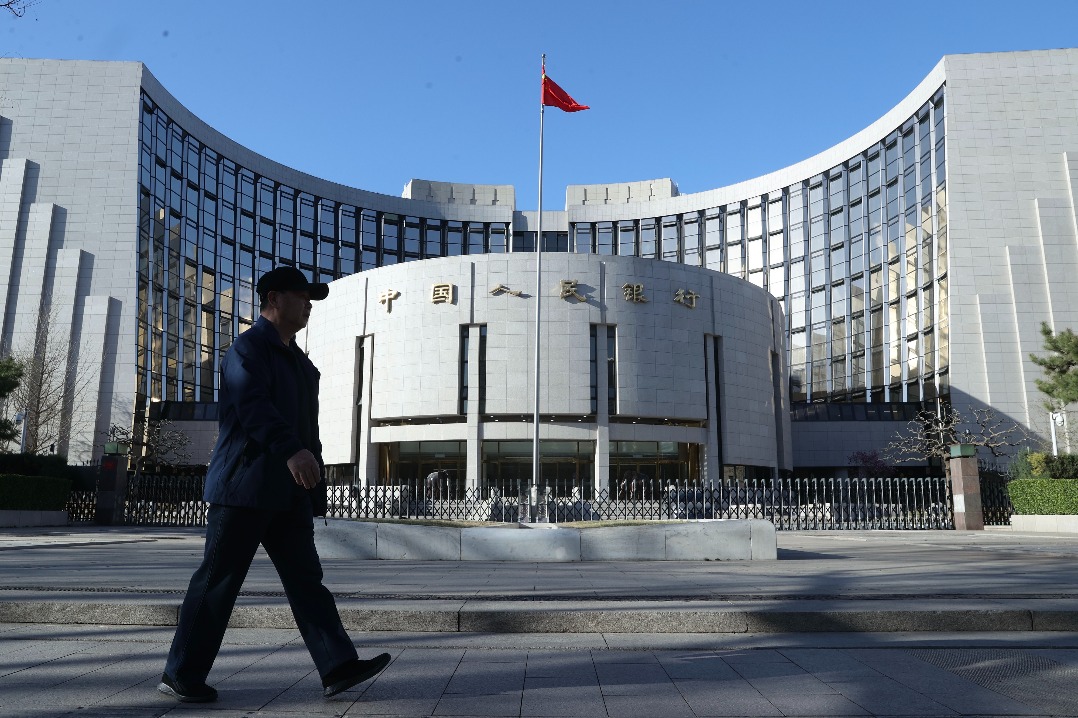

Pan Gongsheng, governor of China’s central bank, provided a comprehensive overview of the evolving characteristics of the country’s financial structure and changes in financing data in his keynote speech at the 2026 Lujiazui Forum on June 17.
Examining the issue from the perspectives of China’s transition to a new stage of economic development, industrial upgrading and financial supply-side reform, Pan offered an in-depth analysis of the underlying logic and key drivers behind the adjustment of the country’s financing structure.
Framed within the broader goals of high-quality development and building China into a financial powerhouse, he also outlined the medium- and long-term direction of China’s financial market modernization, the coordinated development of equity, bond and bank financing, and institutional opening-up of the capital market, providing an authoritative policy framework for assessing key issues such as the expansion of direct financing, optimization of the financial structure and cross-border capital management.
Pan said China’s financial system has long been dominated by bank lending, while financial markets remained relatively underdeveloped. In recent years, however, the share of indirect financing centered on bank loans has continued to decline, while the proportion of direct financing, including bond and equity financing, has steadily increased, signaling profound changes in the country’s financial structure.
Historically, newly added indirect financing consistently accounted for more than 80 percent of the increase in total social financing. In 2025, however, loans represented only 45 percent of new additions to total social financing, while bond and equity financing together accounted for 47 percent, surpassing loans for the first time. In particular, bond financing has become the largest contributor to the growth of direct financing due to its relative stability and flexibility.
In the 1990s, indirect financing accounted for nearly all of China’s outstanding social financing. By the end of 2025, its share had fallen to around two-thirds, while direct financing had risen to approximately one-third.
Today, the historic transformation of China’s financial structure is characterized by shrinking household credit, slower growth in corporate lending offset by faster expansion of direct financing, and rapid growth in government financing. The internal composition of direct and indirect financing has also diverged significantly. Direct financing is now primarily supported by bond issuance, with government bonds accounting for the bulk of the increase in financing. Indirect financing, meanwhile, continues to be dominated by renminbi-denominated corporate loans, while household lending has declined sharply.
Pan said these profound changes fundamentally reflect the deep adjustment of China’s economic structure, the transition from old to new growth drivers, the evolving alignment between the financial system and industrial upgrading, and the continuous deepening of financial supply-side structural reform.
There is little doubt that this major transformation in China’s financial structure is not accidental. Rather, it is the result of multiple long-term factors acting in concert, particularly the upgrading of the country’s economic structure. It represents an adaptive adjustment of the financial system to changes in economic development, industrial composition and market demand. It is also an inevitable outcome of financial supply-side reform and an objective requirement for achieving high-quality economic development.
Over the next five to 10 years, the share of China’s direct financing is expected to continue rising steadily, resulting in a more diversified financial system in which equity, bond and bank financing complement one another.
Equity financing is expected to become a major driver of direct financing growth. Continued reforms to the registration-based IPO system will further lower listing thresholds, streamline listing procedures and facilitate financing for more technology companies, small and medium-sized enterprises, and innovative enterprises. Meanwhile, private equity and venture capital markets are expected to continue expanding, with government guidance funds playing a greater leveraging role in channeling private capital toward seed-stage and early-stage technology companies.
Government bond issuance will remain the cornerstone of China’s direct financing market. To achieve its 2035 development goals, China is expected to maintain a proactive fiscal policy for an extended period, supporting steady growth in government bond issuance and sustaining the expansion of direct financing.
Corporate bond financing is likely to become another major growth engine. Issuance of medium- and long-term corporate bonds is expected to increase rapidly, accounting for a larger share of the market while further optimizing bond maturity structures to better meet the long-term financing needs of the real economy. Issuance of specialized instruments — including technology innovation bonds, green bonds and rural revitalization bonds — is also expected to expand rapidly.
At the same time, China’s credit rating system will continue to improve, and bond default resolution mechanisms will become more robust. Greater connectivity between domestic and international bond markets will further improve market liquidity and the efficiency of capital allocation.
Financial product innovation will accelerate to meet increasingly diverse financing needs. More equity financing products tailored to SMEs and technology companies are expected to emerge. China will continue developing specialized bond products and may introduce new instruments such as floating-rate bonds and green convertible bonds. A broader range of differentiated investment funds and asset management products will also be introduced to better accommodate investors with varying risk preferences.
China will continue expanding the opening-up of its capital markets, steadily advancing the internationalization of its financial markets and promoting institutional opening-up. The country will move forward with the internationalization of the renminbi and the gradual convertibility of the capital account, enrich the offshore renminbi product ecosystem, and strengthen the renminbi’s role in international pricing, settlement and reserve holdings.
At the same time, China will improve its macroprudential management and cross-border capital flow monitoring systems, refine its cross-border risk early warning and resolution mechanisms, and achieve a dynamic balance between high-level opening-up and secure development.
The writer is chairman of the China Chief Economist Forum and president at the institute of international finance of the CCEF. This article is an excerpt from the English translation of the original text published on financial information service provider Sina Finance.
The views do not necessarily reflect those of China Daily.
Tanks to chinadaily.com.cn
Please visit:
Our Sponsor
Like this:
Like Loading…
Разгледайте нашите предложения за Български трактори
Иберете от тук
Българо-китайска търговско-промишлена палата