
Spring is the best time to visit parks. At Beijing’s Summer Palace, benches sit beneath canopies of flowering trees, where petals burst into color and drift through shifting light, and waterbirds glide between moments of flight and stillness across the lake.
Yet Beijing’s parks are no longer just scenic landscapes. They have become open-air classrooms, where lessons in biodiversity are taught through the lively environment.
In mid-April, the city launched the 2026 Biodiversity Conservation Awareness Month at the Summer Palace as part of a broader initiative spanning 14 municipal parks and the Museum of Chinese Gardens and Landscape Architecture.
Running through May 22, the program combines online and in-person activities, offering more than 110 events designed to bring ecological awareness into everyday recreation.
“Plants are blooming, and the waterbirds are so lively. Everything coexists so harmoniously here,” says Yan Shuhan, a fourth-grade student from Xiyuan Primary School.
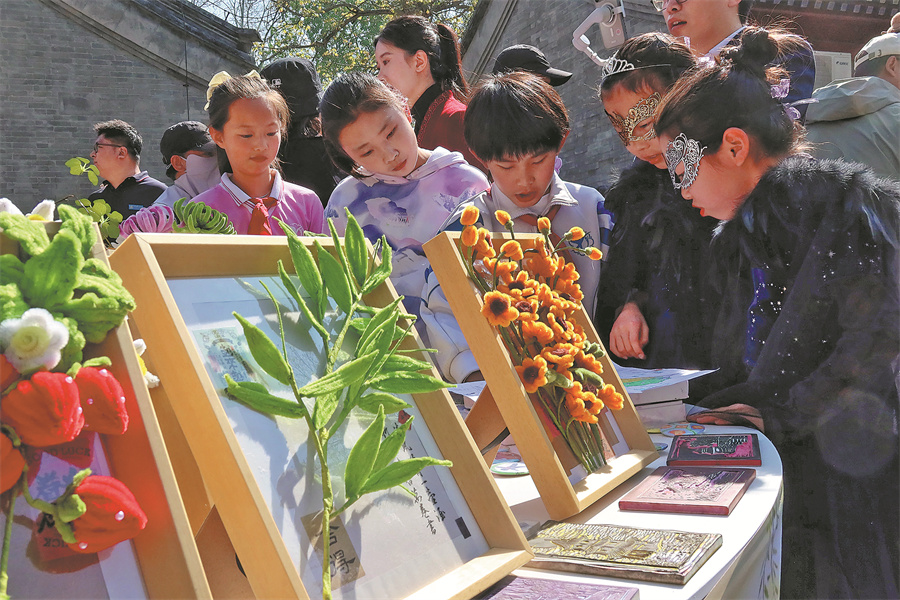
Students from Xiyuan Primary School showcase their handicrafts inspired by the ecological environment of the Summer Palace at the event in April.[Photo provided by Jiang Dong/China Daily]
She brought a handmade badge to the event, depicting the “Shouxing Stone”, a weathered limestone formation in the park said to resemble an elderly figure.
Shuhan is one of roughly 70 student volunteers in her school’s “Little Tour Guide” program, a long-running initiative reflecting the school’s proximity to the historical grounds. Established in 2007, the program trains students to lead volunteer tours for visitors, sometimes in English, while park staff regularly visit classrooms to teach ecology.
When birds once nested beneath the school’s eaves, teachers invited park educators to explain their origins. Students learned they were Beijing swifts, a species named after the city and closely associated with the architecture of the Summer Palace, particularly the Kuoru Pavilion, where many nest.
Encounters with urban wildlife have also shaped students’ creativity. Stray cats, a common sight in the park, inspired a series of student-designed cultural products featuring animals they regularly observe. Some of these works were displayed at exhibition booths, where each participating park presented its own ecological themes.
At a booth representing the Temple of Heaven, 76-year-old retiree Wang Lanli carefully collected a set of colorful stamps. Each one depicts scenes of birdlife in the park, such as two gray-headed woodpeckers clashing during mating season, or red-billed blue magpies perched in winter persimmon trees.
“Look at these birds. They’re remarkable,” Wang says, holding up a freshly stamped card.
Using a wooden carving, a science educator from the Temple of Heaven Park Education Center explains the habits of goshawks to a child.[Photo provided by Jiang Dong/China Daily]
A regular visitor to Beijing’s parks, she rotates her routine among the Summer Palace, the Beijing Botanical Garden and the Temple of Heaven. Rain or snow rarely keeps her away.
“We sing, we walk, we just spend time together,” she says of her visits with friends. “In recent years, the ecological improvements have been obvious. In spring, you can spot dozens of bird species in the water.”
Some species, however, remain elusive. To bridge that gap, students from Beijing Forestry University introduced virtual reality headsets developed in collaboration with Baiwangshan Forest Park. The technology allows users to observe the great bustard — a large, rarely seen bird — in simulated flight.
“In reality, you might never encounter these birds,” says Dai Yuxin, one of the student developers.
“But in a virtual environment, people can understand them more deeply. Technology will play an increasingly important role in conservation.”
Song Lipei, an official with the Beijing Municipal Administration Center of Parks, says: “We are moving from one-way information delivery to immersive, interactive experiences.”
Urban parks, long valued as spaces for leisure, are now being redefined as shared habitats for people and biodiversity. In Beijing, this shift is no longer abstract — it is visible in the landscapes themselves, and in the daily experiences of those who pass through them.
Like this:
Like Loading…
Разгледайте нашите предложения за Български трактори
Иберете от тук
Българо-китайска търговско-промишлена палата