
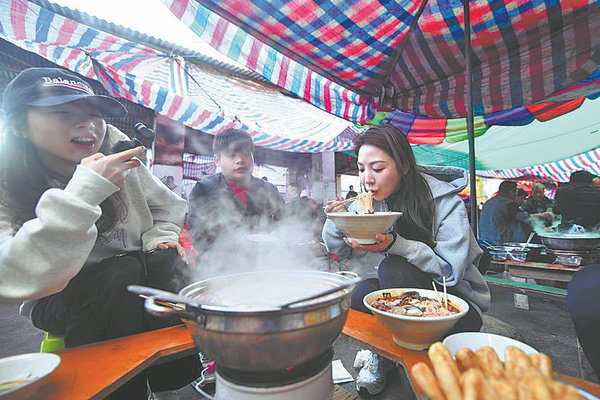
Tourists from Zhejiang province have breakfast at a morning market in Chengtuan town of Liuzhou, Guangxi Zhuang autonomous region, in November 2024. [Photo/Xinhua]
SHENYANG — At 6 am, as the first rays of sunlight hit the Xiaoheyan morning market in the northeastern Chinese city of Shenyang, the air was already thick with the aroma of freshly fried beef pies and steaming tofu pudding.
In this 200-year-old market in Liaoning province, long snaking queues line stalls selling everything from glutinous rice rolls — known as donkey rolls — to large vats of traditional Chinese pickles. Once a humble venue for locals to buy daily groceries, the market has evolved into a must-visit “check-in” spot for tourists seeking an authentic taste of urban life.
The trend of wet markets gaining popularity reflects a shift among young travelers away from traditional sightseeing toward immersive city walks that offer a deep dive into local culture.
“I saw videos of the bustling morning markets in Northeast China on social media and booked a high-speed rail ticket from Beijing just to experience it,” said a tourist surnamed Wang. “The prices are incredibly fair, and the vendors are so hospitable. One stall owner even gave me two extra beef pies for free.”
Consumers check out fresh vegetables at a market on April 10 in Taixing, Jiangsu province. [Photo/Xinhua]
To accommodate the influx of visitors, local authorities in Shenyang have upgraded service standards. These include ensuring accurate weighing with “fair scales”, providing a visitor service center for luggage storage and phone charging, and installing retractable bollards to manage traffic during peak hours.
Strategically located just two kilometers from the Shenyang Palace Museum, the market has been integrated into the city’s official tourism routes, allowing visitors to transition seamlessly from the hustle and bustle of the morning market to the historical grandeur of ancient landmarks.
Across the country, “old markets” are reinventing themselves through “micro renovations” and diversified business models. The Wen’er market in Hangzhou, in East China’s Zhejiang province, now houses trendy cafes and flower shops, even offering a “personal chef” service where vendors stir-fry ingredients bought by customers on the spot.
“Markets are the most vibrant pulse of a city,” said Wang Xiaoyu, a professor at Beijing Sport University. “By retaining their ‘down-to-earth’ atmosphere while expanding their cultural functions, these spaces are becoming new growth points for tourism consumption.”
In Kunming, in Southwest China’s Yunnan province, the Daguanzhuan farmers’ market has developed into a multi-functional space for cultural experiences and leisure, serving as a window into Yunnan’s unique local products.
Wang Xiaoyu said that the popularity of wet markets reflects a move toward “experiential” travel. Tourists are no longer satisfied with simply viewing monuments. They want to touch, taste and participate in the local way of life.
As urban renewal and culture-tourism integration deepen, experts believe more traditional markets will evolve from simple livelihood spaces into cultural landmarks, serving as key drivers to boost urban consumption and showcase a city’s unique charm.
Like this:
Like Loading…
Разгледайте нашите предложения за Български трактори
Иберете от тук
Българо-китайска търговско-промишлена палата