
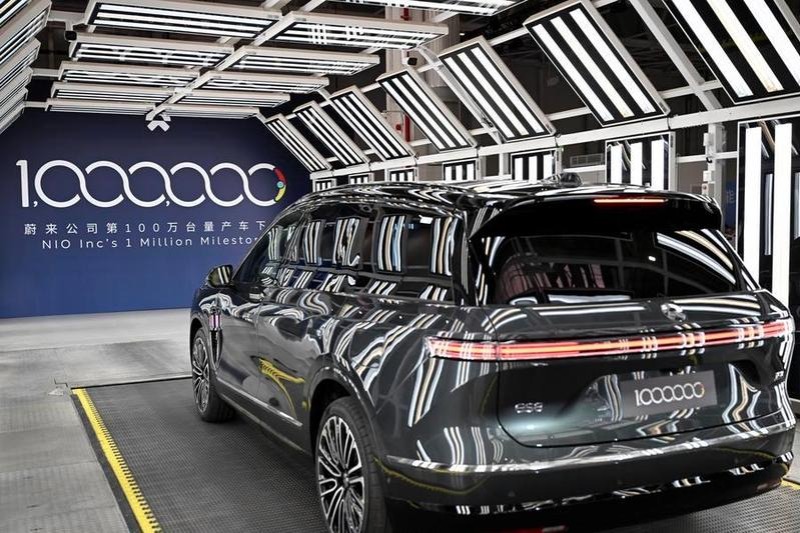

Chinese electric vehicle maker Nio is eyeing full-year profitability in 2026 after delivering on its repeated promise of getting out of the red in the fourth quarter last year.
The 11-year-old company posted its first-ever quarterly profit last week: an adjusted operating profit of 1.25 billion yuan ($178.9 million) and a net profit of 282.7 million yuan, despite a full-year net loss of 14.94 billion yuan in 2025.
After several failed attempts to get into the black, William Li, founder and CEO of Nio, set the fourth quarter of 2025 as the deadline to achieve quarterly profitability, calling it a make-or-break moment.
“The failure to go profitable would throw doubts on our business model and long-term prospects,” Li said.
Following the release of its financial statements, Li said the results reflect Nio’s systematic capabilities and operational efficiency.
Nio delivered a record 124,807 vehicles from October to December, a 71.7 percent increase over the fourth quarter of 2024. Its full-year deliveries totaled 326,028 units, up 46.9 percent year-on-year.
“Nio has officially entered its third stage of development, initiating a new cycle of rapid growth,” Li said.
Looking ahead to the first quarter of 2026, Nio has given guidance for 80,000 to 83,000 vehicle deliveries, up 90 to 97 percent year-on-year, and revenue of 24.48 to 25.18 billion yuan, a growth of 103 to 109 percent.
While investors cheered — Nio’s stock price in Hong Kong rose more than 14 percent the day after the announcement — analysts warned that long-term profitability matters and that the road ahead will not be easy.
The quarterly profit was supported by higher deliveries and temporary cost reductions, including lower R&D and marketing spending, they said.
Nio’s R&D spending fell from 3.18 billion yuan in the first quarter to 2.02 billion yuan in the fourth quarter last year, a 36.4 percent decrease, while the R&D expense ratio dropped from 26.43 percent to 5.83 percent.
For context, Nio had maintained roughly 3 billion yuan per quarter in R&D spending since the third quarter of 2022.
Marketing expenses decreased from 4.4 billion yuan in the first quarter to 3.54 billion yuan in the fourth quarter, a nearly 20 percent reduction, with the marketing expense ratio falling from 36.58 percent to 10.22 percent.
Meanwhile, Nio delivered 47,000 vehicles in the first two months of the year, with its volume brand Onvo contributing fewer than 3,000 units in February.
That marked a jump from the same period last year, but the company would need to deliver at least 33,000 units in March to meet its first-quarter guidance of 80,000 units.
Li remains confident. He said Nio will unveil three new models this year — the Nio ES9, the Onvo L80 and a large five-seat SUV based on the ES8 platform — and expects sales growth of 40 to 50 percent.
CFO Stanley Yu Qu reaffirmed the company’s commitment to achieving full-year non-GAAP profitability.
“We will continue to maintain R&D spending of 20 billion to 25 billion yuan per year while improving efficiency through our Cell Business Unit operating model, ensuring maximum output without unnecessary investment.”
Qu also noted that the company expects to sustain vehicle gross margins in the first quarter of 2026 at the fourth-quarter 2025 levels, helped by a strong product mix including the ES8 and large SUVs.
“Maintaining disciplined R&D and marketing investment is critical,” Qu said. “We are focused on increasing returns on the same level of investment and improving operational efficiency to support sustainable profitability.”
Nio also emphasized its charging and battery-swap strategy, which drew doubts after BYD announced an ultra-fast charging solution that can charge most of its vehicles from 10 to 97 percent in nine minutes.
Li stressed that ultra-fast charging and battery swapping are complementary, not mutually exclusive, designed to meet different energy needs.
“We are glad to see more companies participate in building EV energy networks,” Li said. “Fast charging and battery swapping will jointly accelerate the transition from fuel vehicles, hybrids and plug-in vehicles to pure EVs.”
Analysts say the market will closely watch whether the milestone quarter can translate into sustained profitability, especially amid intensifying competition in China’s EV market.
The China Association of Automobile Manufacturers expects the Chinese auto market to remain broadly flat this year compared with 2025.
[email protected]
Tanks to chinadaily.com.cn
Please visit:
Our Sponsor
Like this:
Like Loading…
Разгледайте нашите предложения за Български трактори
Иберете от тук
Българо-китайска търговско-промишлена палата