

2025 starts with an EV dispute, but it ends with something broader: EU China ties begin to look less like trade management and more like security first.
The EV tariff dispute has stopped being a single trade case. It has become the organising principle of EU–China economic relations. The timing matters. Europe is already living with a war on the continent and a sense that the rules of the international system are under strain. In Brussels, China is increasingly discussed not only as an economic competitor, but as a geopolitical factor. The EU view that China is helping Russia’s war economy endure, whether through trade flows, loopholes, or diplomatic cover, hangs over every economic conversation.
It is hard to negotiate calmly about electric cars when the bigger argument isabout security in Europe.
It is no longer satisfied with complaining about market access, or issuing statements that change nothing. It begins to use tools built for reciprocity and economic security. In mid-January, it signals it will move from diagnosing discrimination against EU suppliers in China’s medical-device procurement market to deciding “next steps”. The phrasing is dry, but the meaning is not.
It signals the EU is preparing to act, not just to argue.
 In terms of manufacturing capacity China produces 87% of solar cells and 97% of photovoltaic panels (IEA report 2025) EU solar supply chain remains overwhelmingly China-made
China’s approach through the year is to keep the relationship workable, but uncomfortable. There is plenty of rhetoric, very little concession. Not a rupture. Not a reset. Instead, targeted pressure is applied to sectors that carry political weight in Europe, pressure that can be scaled up or dialled down depending on how the EV talks are going. At the same time, Beijing leans harder into bilateral engagement with member states. It is a familiar rhythm in EU–China relations: if Brussels becomes more assertive, widen the lanes where influence is easier to exercise, i.e., the member states themselves.
By spring, Beijing seems genuinely alarmed by the scepticism that now runs through European capitals and institutions. It delays the most punitive step in the French cognac dispute, creating the appearance of dialogue while keeping the threat firmly alive. That is a trademark move. It does not close the door, but it stands in the doorway. The message is subtle but clear: you can talk, but you will talk under pressure.
Around the same time, the EU and China explore a minimum-price approach for EVs, an attempt to find an off-ramp from tariffs without either side losing face. The mood is cautious rather than hopeful. A workable off-ramp requires trust, and 2025 is not a trust-building year. Both sides negotiate with one hand while keeping retaliation options in the other.
Then, before summer even begins, Europe’s attention is pulled towards something more basic than tariffs. Materials. Rare earths. The boring ingredients that make modern industry work.

As China tightens export controls and licensing on rare-earth-related products, the message that European industry hears is not simply administrative. It sounds strategic. China can loosen or tighten the flow of inputs that Europe depends on, and it can do so with limited notice. Even when licences are granted, the lesson remains that supply runs through a gate.
The EU responds by building a gate of its own. It deploys the International Procurement Instrument and restricts Chinese medical-device firms from major EU public tenders, with a widely cited threshold of €5 million. The principle is simple, and it is likely to be repeated in other areas: if European firms face systematic barriers in China, Chinese firms should not automatically enjoy frictionless access in Europe.
China responds quickly, and explicitly, with procurement restrictions of its own. Retaliation becomes more direct and more symmetrical. In early July, China’s brandy duties arrive, reportedly up to 34.9%, with exemptions structured around minimum-price commitments for some producers. It is pressure with conditional relief. Pain but with a rulebook.

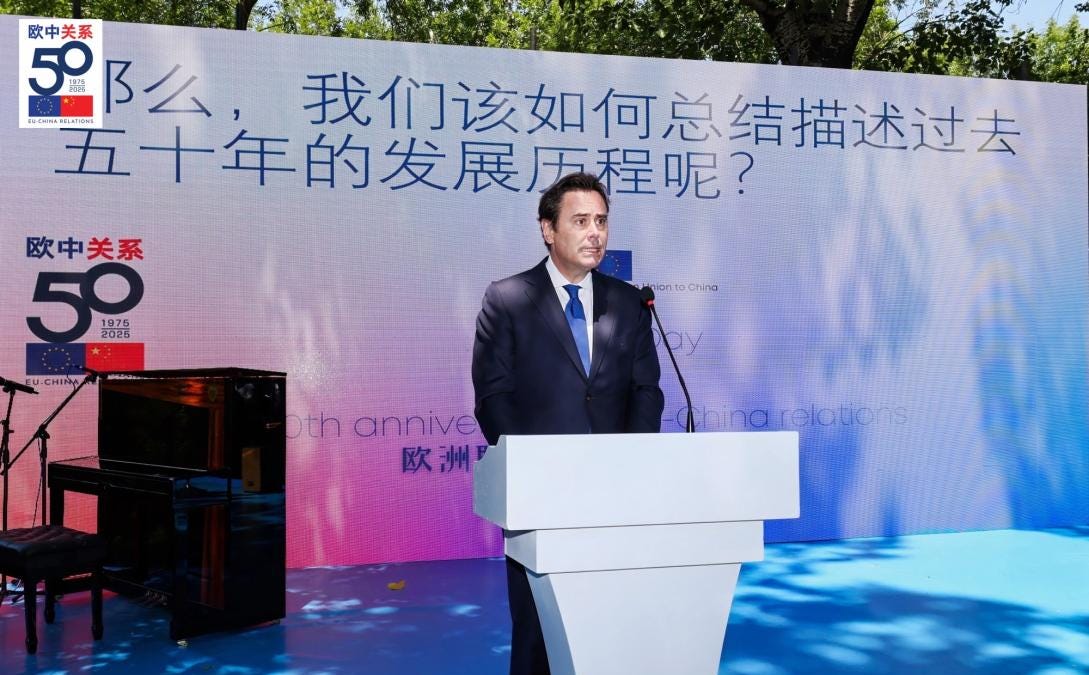
All of this flows into the EU–China summit in Beijing on 24 July, a meeting that marks 50 years of diplomatic ties but feels like a negotiation about the next 50. Trade sits at the centre. Ukraine is explicitly on the table. Critical minerals hover in the background like a shadow. European leaders arrive with low expectations, and the summit does little to change them, except for limited cooperation language on climate.
If you wanted a single moment that captures the year’s mood, it is that summit. A symbolic anniversary, a crowded agenda, and the sense that the relationship has become more transactional and more guarded at the same time.
And then, almost immediately, the relationship shifts from tense management into a broader summer of discontent.
In August, China extends its dairy probe. In September, the pork case turns punitive, with large provisional security deposits applied to EU exporters. Press reports put provisional levels as high as roughly 60% for some categories. The logic is not hidden. If Europe is going to defend itself industrially, China will show it can impose costs on European exporters in sectors that matter politically at home: farmers, regional producers, and industries with loud domestic constituencies.
Early autumn brings the year’s most distinctive episode, because it is not primarily about tariffs at all. The Dutch state intervenes in Nexperia, a strategically placed chipmaker owned by China’s Wingtech, using powers under the Dutch Availability of Goods Act. What looks at first like a national governance measure becomes, within days, a supply-chain event. China issues export controls affecting Nexperia-related products packaged in China, and Europe’s auto sector warns of disruption.

This is the point where EU–China friction looks less like “trade defence” and more like chokepoint politics. Who controls production. Who controls packaging and distribution. Who can legally block what, and for what reasons. In a relationship once dominated by tariff lines and market-access disputes, the centre of gravity shifts to something colder: control over bottlenecks.
In November, China partially eases the Nexperia restrictions for civilian use, a pragmatic move to reduce the shock, especially for automakers. But the incident has already done its strategic work. It demonstrates how quickly a corporate governance dispute can become an international economic-security event, and how easily commercial ties can be weaponised through administrative controls rather than headline bans.
At the same time, the EU raises the geopolitical temperature further with its 19th Russia sanctions package, which includes listings connected to entities in China. The message is plain. Brussels no longer treats geopolitics as a separate channel from economic relations. If China is seen as helping Russia sustain its war economy, that will spill into the broader relationship, regardless of what is being negotiated on EVs or procurement.
By December, both sides are effectively writing their positions into the structure of the relationship. The EU launches a fresh economic-security push centred on raw materials and resilience. China confirms streamlined rare-earth licensing. The pork case ends with lower but lasting duties, reported in the range of roughly 5% to 20% for five years, far below the provisional deposit shock. And the dairy case escalates into provisional tariffs reaching 42.7%.
So 2025 closes in a very 2025 way. Negotiations still exist, but every major file now carries a built-in retaliation option. Tariffs and probes in food. Duties and minimum prices in spirits and EVs. Procurement as leverage. Export controls as pressure. Economic security as doctrine.
A signature ceremony between the EU and the Mercosur countries is expected to take place January 17 in Paraguay. After 25 years of talks, the EU–Mercosur deal enters largely uncharted territory. Its signature is shaped more by recent geopolitical shocks than by trade.
On paper, MERCOSUR trade is overwhelmingly Brazil.
 Venezuela remains suspended from MERCOSUR: it is still a member on paper, but it has no rights. The suspension stays until MERCOSUR deems democratic order restored.
Yet geopolitics is not weighted like a pie chart. China’s influence in the region is built as much through finance, infrastructure, and technology ecosystems as through merchandise flows.
 China watchers will not miss a small but telling detail: Paraguay, a MERCOSUR member, still recognises Taiwan
That is why an EU–MERCOSUR agreement can be commercially ‘about Brazil’, while strategically being about something wider:
whether Europe still has a meaningful role in shaping the region’s standards, supply chains, and diplomatic alignment. Time will tell.
A 7 January presidential memorandum, following a Trump executive order from early 2025, directs U.S. agencies to withdraw from 66 international organisations, including multiple UN entities.
Five of the 66 are directly tied to trade. Another 26 connect indirectly through commodities, shipping, energy, standards, and the digital economy. Total trade-linked: 31, including 10 UN entities. Taken together, this looks less like a narrow clean-up and more like a statement about the UN itself.

The OECD says governments have agreed a “way forward” on the global minimum tax. The details are technical, but the direction is simple:
it becomes harder for multinationals to park profits in a low-tax jurisdiction when the real activity is happening somewhere else.
That matters more for trade in services than for goods. A factory has to be built in a place; many services can be sold across borders while profits are booked where tax is lowest, often by locating intellectual property or financing in a favourable jurisdiction.
The minimum tax is meant to shrink that gap: if profits are booked in a low-tax location, another country can “top up” the bill. The likely shift is from tax-driven “booking hubs” toward places with real operations.
China isn’t an OECD member, but it is part of the OECD Inclusive Framework that backed this approach, so it is affected too.
Plug-in hybrid exports surge 157%; combustion cars fall 8%, non-plug-in hybrids fall 39%, and EVs rise 9%.
 Share calculated by value
China’s car exports crossed $100 billion in 2025 for the first time. Combustion cars still lead the mix, and Russia absorbs roughly one-fifth of those shipments.

Subscribe for free to receive new posts and support our work!
We are committed to sharing with you the best trade analysis we have to offer. If you would like to share something with us, feel free to comment in the section below or drop us a line at [email protected]
Like this:
Like Loading…
Разгледайте нашите предложения за Български трактори
Иберете от тук
Българо-китайска търговско-промишлена палата