

China is stepping up efforts to boost domestic demand by placing greater emphasis on raising people’s incomes, expanding consumption capacity and fostering stronger internal economic circulation, in a bid to address persistent demand shortfalls and support more sustainable growth, the country’s top economic regulator said on Tuesday.
Analysts said the latest signals underscore the resolve of policymakers to shift the next stage of economic development toward demand-driven growth, while pressing ahead with deeper income distribution reforms to rebalance growth drivers amid still-weak domestic demand and rising external uncertainties.
According to the National Development and Reform Commission, authorities are studying measures to stabilize employment and create more jobs while improving employment quality, alongside pushing initiatives to advance urban-rural income growth plans. The goal is to enhance the spending power of consumers while better aligning the supply of goods and services with evolving demand.
Zhou Chen, director of the NDRC’s Department of National Economy, told a news conference in Beijing on Tuesday that domestic demand has already become the economy’s “stable anchor”.
In 2025, China’s per capita disposable income rose 5 percent in real terms, in line with overall economic growth, providing a key underpinning for domestic demand expansion. Domestic demand contributed more than 67 percent of overall economic growth last year, with consumption accounting for 52 percent, official data showed.
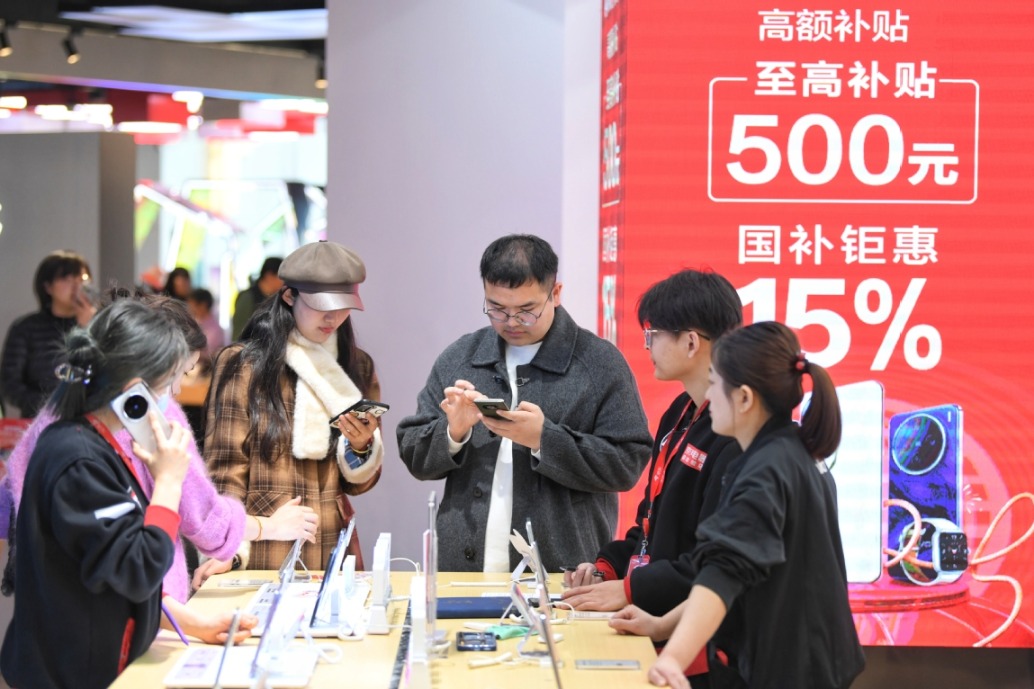
Zhou said that China will continue implementing its consumer goods trade-in program this year while advancing a broader campaign to boost consumption by fostering high-impact, highly visible new consumption scenarios.
He highlighted the services sector as a key focus area for expanding domestic demand, saying that the country will roll out an action plan to expand capacity and upgrade quality in the services sector, supported by a package of high-value policy measures aimed at promoting more efficient and higher-quality development.
The latest economic data has already shown the official snapshots of the persistent pressures from still-weak domestic demand, as retail sales, a key indicator of consumer spending, increased by 0.9 percent in December, compared with 1.3 percent growth a month earlier.
Wang Changlin, deputy head of the NDRC, said, “China’s economy is indeed facing a situation where supply is relatively strong while demand remains weak.”
To address this imbalance, Wang said macroeconomic policy will continue to prioritize strengthening the domestic economic cycle and fully expanding domestic demand. Authorities are preparing a strategic plan for expanding domestic demand for the period 2026 to 2030, designed to align with consumption upgrades and the new round of technological and industrial transformation.
According to the Recommendations of the Central Committee of the Communist Party of China for Formulating the 15th Five-Year Plan for National Economic and Social Development, China should, over the next five years, create more models of economic growth that are led by domestic demand, driven by consumption, and sustained by self-generating momentum.
Wen Bin, chief economist at China Minsheng Bank, said that despite downward pressures ahead, he believes retail sales growth could rebound to around 5 percent in 2026, as consumer confidence gradually recovers, the drag from the property market eases, and policy support intensifies across consumption and services.
Huang Hanquan, head of the Chinese Academy of Macroeconomic Research, said that over the short term, the priority should be stabilizing expectations and incomes to support consumption, including refining existing policies to better support services consumption and removing unreasonable restrictions, which could quickly unlock demand.
In the long run, he said, China needs to strengthen its underlying capacity by improving institutional arrangements and building an endogenous growth model led by domestic demand and consumption.
“This requires optimizing income distribution and improving social security systems — including pensions, healthcare and unemployment insurance — to reduce precautionary savings and encourage households to spend,” he said.
Citing China’s vast consumer base, expanding domestic demand and clear policy direction, Mexican multinational food company Grupo Bimbo said it is doubling down on its long-term commitment to China.
“We are full of confidence in the long-term potential of China’s consumer market,” said Kelly Zhang, general manager of Bimbo China.
“Grupo Bimbo will continue to leverage its global leading research and development capabilities and localized operations to deliver higher-quality products and services, and to honor our commitment to consumers.”
 Contribution of domestic demand to economic growth CHINA DAILY
Tanks to chinadaily.com.cn
Please visit:
Our Sponsor
Like this:
Like Loading…
Разгледайте нашите предложения за Български трактори
Иберете от тук
Българо-китайска търговско-промишлена палата